Structured Experimentation with Real Companies
Pivot Labs are CEO-led working sessions focused on a single, clearly defined economic constraint. Each lab begins with operating reality, not theory.
Initial Lab Focus Areas
Pivot Labs are addressing the affordability crisis, environmental challenges, and community economic fragility. Each lab is designed around exploring and solving - redesigning systems to create a more equitable future.
How a Lab Works
Define
Define the constraint or challenge clearly.
Map
Map incentives and tradeoffs.
Design
Design potential solutions and run bounded experiments.
Model
Model outcomes before scaling.
Implement
Implement, document, and analyze results.
Elevate
Make the case to appropriate governmental officials and policy makers as necessary.
Pivot Lab Approach
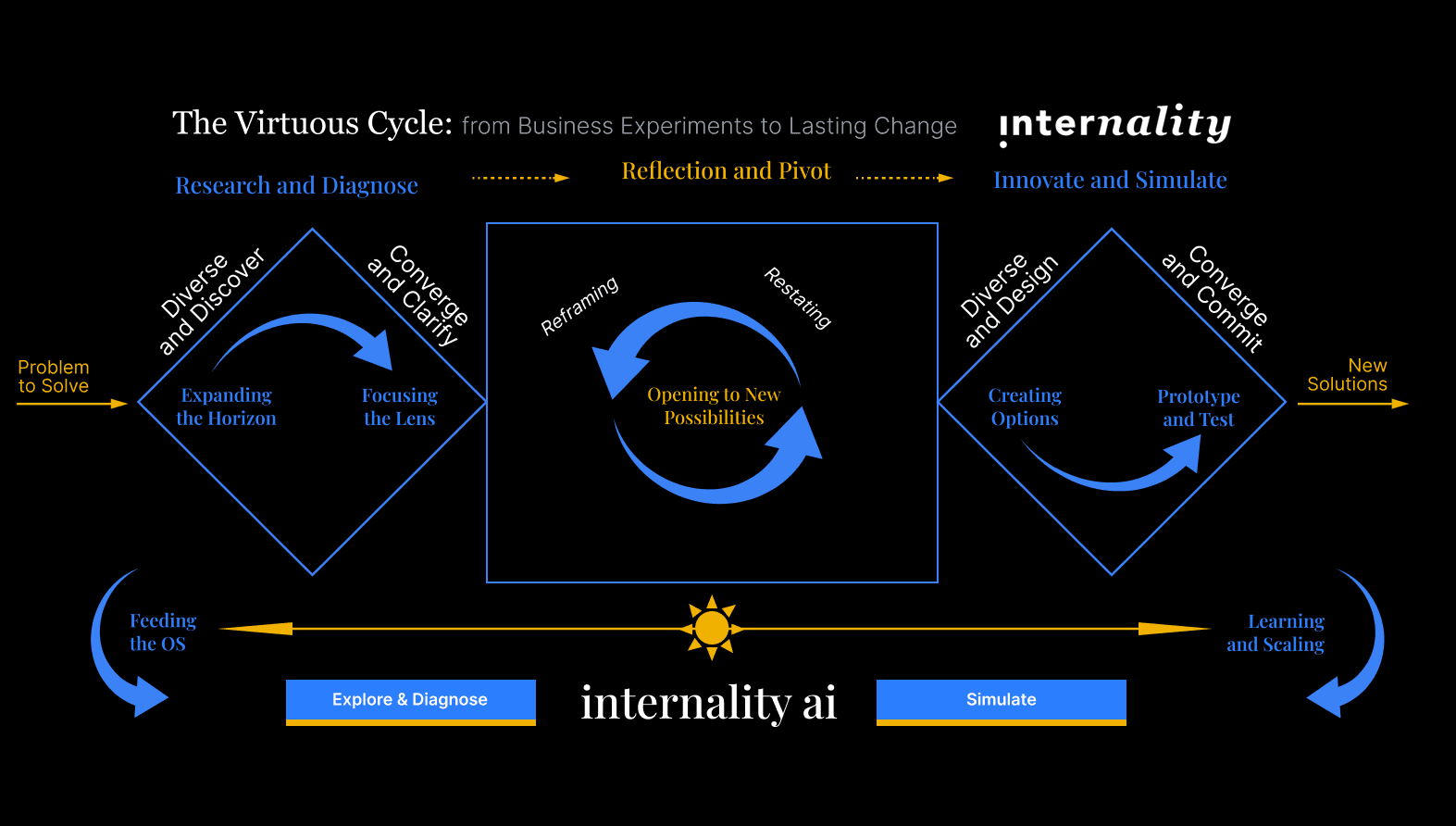
Internality.ai Informs and Accelerates Through Simulation
What Comes Out
Documented Experiments
Rigorous documentation of each experiment and its conditions.
Replicable Interventions
Interventions designed to be adapted and applied by other organizations.
Modeled Tradeoffs
Clear models of tradeoffs so leaders can make informed decisions.
Applicable Evidence
Evidence ready for broader application across sectors and contexts.
Recursive Knowledge Base
Evidence that informs InterNality OS, enabling comprehensive simulations of business systems.
Systemic Change
Accumulation of a corpus of business innovation for transformation to a new economy.
Labs turn uncertainty into insight and insight into action.
FIRST PIVOT LAB — NOW FORMING
Addressing the Affordability Crisis in West Michigan
Our inaugural Pivot Lab is forming in western Michigan, bringing together CEOs of mid-to-large privately held companies to tackle a shared constraint: how to make compensation and benefits work for employees and businesses in an era of rising costs and stagnant real wages.
The problem is concrete. In the Grand Rapids region, $30/hour is what's needed to live without financial stress — yet a significant share of employees at even well-managed companies are barely making it paycheck to paycheck. The current system forces employees to navigate a complex maze of wages, benefits, and government assistance programs that were never designed to work together.
This lab won't produce a white paper. It will produce tested interventions: new approaches to compensation structure, benefits design, and cross-company career mobility that participating CEOs commit to implementing in their own organizations. Academic partners will rigorously evaluate the results. What works gets documented and shared through InterNality OS so other companies and regions can adapt and adopt.
- Format: 3–4 working sessions over several months, each 3–4 hours, with structured prework and diagnostic analysis between sessions.
- Participation: By invitation.
- Partners: University of Michigan Ross School of Business (research), The Source (workforce data).